Top 10 AI Feasibility & POC Companies for Startups in 2026
-
Introduction
Artificial intelligence can create significant opportunities for startups, but building a complete AI product without validating the idea first can create unnecessary technical and financial risk. A concept may look promising in a presentation but still face challenges related to data quality, model accuracy, infrastructure, integration, scalability, or business value.
This is where AI feasibility and Proof of Concept (POC) services become useful.
An AI feasibility assessment helps determine whether an AI idea is technically and commercially practical, while a POC creates a focused working prototype to test the most important assumptions before moving into full-scale development.
For startups, this approach can help validate an idea, understand technical requirements, demonstrate a concept to investors, and make better decisions about MVP development.
This article highlights 10 AI feasibility and POC companies startups can consider in 2026. The list is intended as a practical selection rather than an objective industry ranking. Startups should compare providers based on their AI expertise, data requirements, technical approach, budget, timeline, and ability to move a validated POC toward production.
What Is an AI Feasibility Study and POC?
An AI feasibility assessment evaluates whether an AI concept can realistically work with the available technology, data, infrastructure, budget, and business requirements.
An AI Proof of Concept goes one step further by creating a focused working prototype to test the idea in practical conditions.
For example, a startup may have an idea for an AI customer-support assistant.
Instead of immediately developing the complete platform, the startup could first create a POC that:
- Connects to a limited knowledge base
- Tests an AI model
- Evaluates response accuracy
- Measures response time
- Tests real customer questions
- Estimates infrastructure and API costs
- Identifies technical limitations
- Determines whether the concept should proceed to MVP development
The goal is not to build the final product. The goal is to generate enough evidence to make a confident decision.
Why Startups Need AI Feasibility and POC Services in 2026
Startups often have limited budgets, small development teams, and pressure to demonstrate product-market potential quickly.
An AI POC can help reduce uncertainty before larger investments are made.
1. Validate the AI Idea
A POC can determine whether the proposed AI technology can actually solve the intended problem.
2. Test Real Data
AI performance depends heavily on data quality. Testing with representative data can reveal problems before full development begins.
3. Reduce Development Risk
A focused prototype can expose technical challenges related to models, APIs, integrations, infrastructure, and workflows.
4. Support Investor Discussions
A working prototype can give founders something tangible to demonstrate to investors and stakeholders.
5. Estimate Development Requirements
A POC can help teams understand the technologies, infrastructure, development effort, and operational requirements involved in building the final product.
6. Improve MVP Planning
POC findings can help startups determine which features should be included in the first production version.
Top 10 AI Feasibility & POC Companies for Startups in 2026
1. Dev Technosys
Dev Technosys provides dedicated AI Feasibility & POC Services designed to help startups and businesses validate AI ideas before committing to full-scale development.
Its service includes AI feasibility assessment, rapid POC development, data readiness validation, AI strategy consulting, and model feasibility testing. The company also focuses on testing AI concepts using real inputs and producing measurable results.
Key Capabilities
- AI feasibility assessment
- AI POC development
- Rapid AI prototyping
- Data readiness validation
- Model feasibility testing
- AI strategy consulting
- Accuracy benchmarking
- Technical risk assessment
- Cost estimation
- Architecture recommendations
- Go/no-go recommendations
- POC-to-production planning
Dev Technosys' approach distinguishes a feasibility POC from a traditional desk-based feasibility study by using a working prototype and real data to test whether the proposed AI solution can work under practical conditions.
This makes Dev Technosys a relevant option for startups that want to validate an AI product idea before investing in full MVP or production development.
2. TechnoYuga
TechnoYuga provides AI Proof of Concept Development Services focused on validating AI concepts before full-scale implementation.
Its services cover AI feasibility consulting, prototype development, model validation, data preparation, performance testing, ROI analysis, AI integration for pilot projects, and POC-to-production transition.
Key Capabilities
- AI strategy and feasibility consulting
- AI prototype development
- AI model validation
- Data preparation
- AI use-case evaluation
- ROI analysis
- AI integration
- Agentic AI POCs
- Enterprise AI POCs
- POC-to-production support
TechnoYuga can be considered by startups that want to test an AI concept while also planning a potential transition from prototype to MVP or production.
3. Salt Technologies AI
Salt Technologies AI offers an AI Proof of Concept Sprint designed to test AI ideas using real business data before larger investments are made.
Its POC process focuses on working prototypes, performance benchmarks, architecture documentation, cost-per-query analysis, and go/no-go recommendations.
Key Capabilities
- AI proof of concept development
- AI feasibility testing
- Working AI prototypes
- RAG POCs
- Document extraction POCs
- AI agent workflow POCs
- Predictive analytics POCs
- AI search and recommendation testing
- Performance benchmarking
- Production planning
The company states that its POCs are designed to evaluate factors such as accuracy, latency, throughput, and cost using the customer's actual data.
4. Symphony Solutions
Symphony Solutions provides AI Proof of Concept Development Services focused on validating both technical feasibility and business value.
Its approach includes defining success criteria, assessing data readiness, building a prototype, testing results, and developing an ROI-based business case.
Key Capabilities
- AI feasibility assessment
- AI POC development
- Data readiness assessment
- Prototype development
- Performance testing
- ROI evaluation
- Cost estimation
- Go/no-go recommendations
- AI implementation roadmap
Symphony Solutions can be relevant for startups that want their POC to answer not only whether an AI solution can be built, but also whether the proposed solution makes business sense.
5. Uvik Software
Uvik Software provides AI consulting and proof-of-concept services focused on helping businesses identify AI use cases worth pursuing.
Its approach combines feasibility analysis, ROI assessment, data readiness evaluation, governance considerations, and working POC development.
Key Capabilities
- AI feasibility assessment
- AI use-case evaluation
- ROI analysis
- Data readiness assessment
- AI consulting
- AI POC development
- Machine learning
- AI governance
- Technical validation
Uvik Software can be considered by startups that have several potential AI ideas and need help determining which use case should be validated first. Its current offering specifically describes feasibility assessment followed by a working POC.
6. AI Superior
AI Superior provides AI consulting and development services for startups, including feasibility validation and Proof of Concept development.
Its startup-focused approach covers the progression from validating technical feasibility to building a POC, MVP, and eventually a production system.
Key Capabilities
- AI feasibility validation
- AI consulting
- AI POC development
- Machine learning
- Generative AI
- Natural language processing
- Computer vision
- AI MVP development
- Production AI development
AI Superior is particularly relevant to startups that want a staged approach where technical risk is assessed before moving toward an MVP and production system.
7. SolGuruz
SolGuruz provides AI POC Development Services focused on validating AI ideas using real data before a startup commits to a full development budget.
Its POCs can cover generative AI assistants, retrieval systems, autonomous agents, document intelligence, computer vision, and predictive models.
Key Capabilities
- AI feasibility validation
- AI POC development
- Generative AI POCs
- RAG systems
- AI agents
- Document intelligence
- Computer vision
- Predictive analytics
- Performance evaluation
- Risk assessment
SolGuruz can be considered by startups that need to test a specific AI capability and obtain measurable evidence before moving toward a larger implementation.
8. Folio3 AI
Folio3 AI provides AI POC and MVP development services designed to help organizations validate AI concepts, assess data readiness, evaluate AI performance, and reduce risks before scaling.
Its approach connects POC development with longer-term AI product development.
Key Capabilities
- AI feasibility assessment
- AI POC development
- AI MVP development
- Data readiness evaluation
- AI performance validation
- ROI assessment
- AI prototyping
- Enterprise AI solutions
- AI product development
Folio3 AI can be considered by startups that want to validate an AI product concept and potentially continue into MVP development after the initial POC.
9. Codewave
Codewave provides AI POC Development services designed to help businesses test AI ideas, evaluate feasibility, measure potential business value, and determine what should be scaled next.
Its approach focuses on rapid AI prototyping and aligning POC development with business objectives.
Key Capabilities
- AI POC development
- AI feasibility validation
- Rapid AI prototyping
- AI product strategy
- Use-case evaluation
- Business-value validation
- AI implementation planning
Codewave can be considered by startups that need a focused prototype to determine whether an AI concept is worth taking into broader development.
10. Kizzy Consulting
Kizzy Consulting provides AI POC and MVP development services designed to validate enterprise AI ideas before full-scale investment.
Its process connects feasibility testing with AI prototype development and eventual MVP engineering.
Key Capabilities
- AI POC development
- AI feasibility validation
- AI MVP development
- AI agent development
- AI automation
- LLMOps
- CRM-based AI solutions
- Enterprise AI product engineering
Kizzy Consulting can be considered by startups and organizations looking for a pathway from AI feasibility testing to a market-ready MVP.
Common Types of AI POCs for Startups
Different startups require different types of AI proof of concepts.
Generative AI POC
A startup can test whether generative AI can produce useful content, responses, summaries, or recommendations for a specific use case.
RAG POC
A Retrieval-Augmented Generation prototype can test whether an AI system can retrieve relevant information from a startup's documents or knowledge base and generate useful answers.
AI Agent POC
An AI agent POC can test whether an autonomous or semi-autonomous agent can complete defined tasks using APIs, tools, databases, or business applications.
Computer Vision POC
Computer vision prototypes can test image or video-based use cases such as object detection, quality inspection, document processing, or visual analysis.
Predictive Analytics POC
Predictive AI POCs can determine whether historical business data contains enough useful information to support forecasting, classification, churn prediction, demand prediction, or anomaly detection.
Conversational AI POC
A startup can build a focused conversational AI prototype to test customer support, internal assistance, sales, or knowledge-management scenarios.
What Should Startups Evaluate Before Choosing an AI POC Company?
Choosing a POC provider should involve more than looking at development prices.
AI Expertise
Check whether the company has experience with the AI technology required for your idea.
Data Experience
Ask how the provider evaluates data quality, availability, privacy, and readiness.
Technical Validation
The POC should test the actual technical risk instead of simply creating an impressive demonstration.
Business Validation
A strong POC should help answer whether the proposed AI solution provides enough value to justify further investment.
Scalability
Ask whether the prototype architecture can inform a future production system.
Security
Startups should understand how their proprietary data, customer information, source code, and AI assets will be protected.
Ownership
Clarify ownership of:
- Source code
- Data
- Models
- Prompts
- Documentation
- Architecture
- Prototype components
POC-to-MVP Support
If the POC succeeds, determine whether the company can help transform the validated concept into an MVP or production application.
AI Feasibility Study vs AI POC vs MVP
These three stages are often confused.
AI Feasibility Study
A feasibility study evaluates whether an AI concept is practical from technical, business, financial, and operational perspectives.
AI Proof of Concept
A POC creates a focused working prototype to validate important technical and business assumptions.
AI MVP
An MVP is a usable product with enough functionality to test with real users and gather market feedback.
A typical startup journey can therefore look like:
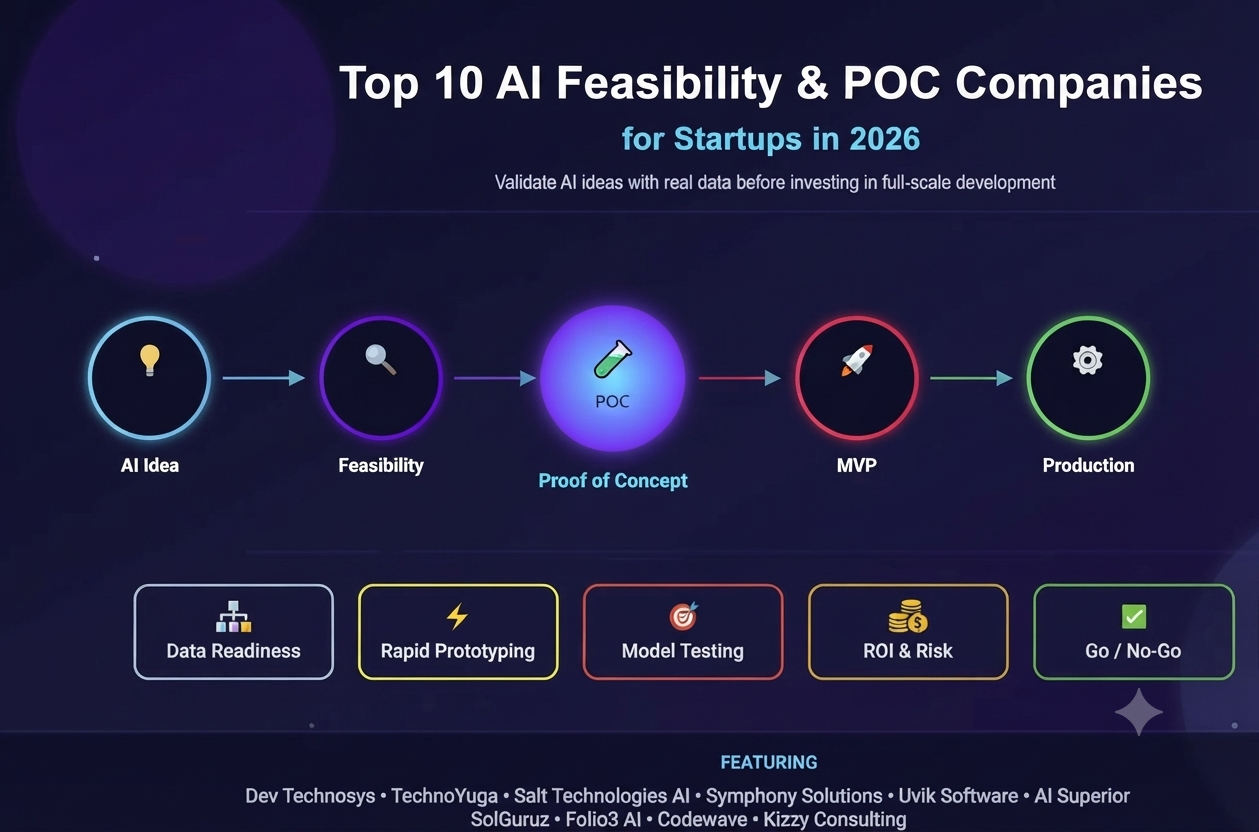
AI Idea → Feasibility Assessment → POC → MVP → Production Product
The exact process can vary depending on the complexity and risk of the AI project.
How Much Does an AI POC Cost in 2026?
There is no single price for an AI proof of concept.
Costs depend on factors such as:
- AI technology
- Data availability
- Data preparation requirements
- Model complexity
- Number of integrations
- Prototype scope
- Security requirements
- Infrastructure
- Testing requirements
- Performance benchmarks
- Timeline
- Whether custom model development is required
A simple AI API prototype may require significantly less effort than a computer vision, RAG, AI agent, or predictive analytics POC involving multiple data sources.
Startups should therefore request a project-specific estimate after defining the use case and success criteria.
Steps to Build an AI POC
A practical AI POC process can include:
Step 1: Define the Problem
Clearly identify the business problem the AI solution should solve.
Step 2: Identify the Riskiest Assumption
Determine what needs to be proven before investing in full development.
Step 3: Assess Data
Review data availability, quality, structure, security, and accessibility.
Step 4: Select the Technology
Choose appropriate models, APIs, frameworks, databases, and infrastructure.
Step 5: Build the Prototype
Develop only the functionality necessary to validate the key assumptions.
Step 6: Test the Prototype
Measure performance using predefined success criteria.
Step 7: Evaluate Business Value
Consider accuracy, user value, operating costs, scalability, and expected business impact.
Step 8: Decide the Next Step
Based on the evidence, choose whether to:
- Stop the project
- Modify the concept
- Run another experiment
- Build an MVP
- Move toward production
Questions to Ask an AI POC Development Company
Before hiring a provider, startups can ask:
- Have you developed AI POCs similar to our use case?
- How will you evaluate the feasibility of our idea?
- What data will you need from us?
- Which AI models or technologies would you recommend?
- What exactly will the POC deliver?
- What metrics will determine whether the POC succeeds?
- How will AI accuracy be measured?
- How will data security be handled?
- Who owns the prototype and source code?
- Can you help us move from POC to MVP?
- How will the future production architecture be planned?
- What will happen if the POC shows that the idea is not technically feasible?
Common AI POC Mistakes Startups Should Avoid
Building Too Much
A POC should answer a specific question rather than attempt to become the entire product.
Using Unrealistic Data
A prototype should be tested with representative data whenever possible.
Ignoring Costs
Model usage, infrastructure, APIs, storage, and ongoing maintenance can affect the commercial viability of an AI product.
Focusing Only on the Demo
A visually impressive demo does not necessarily prove that the AI solution is accurate, scalable, or commercially viable.
Skipping Success Metrics
Before development begins, define what the POC needs to demonstrate.
Forgetting Security
Startup data and intellectual property can be valuable. Security should be considered from the beginning.
Moving to MVP Without Evidence
A successful POC should provide evidence that supports the next development decision.
FAQs
What is an AI feasibility POC?
An AI feasibility POC is a focused working prototype designed to determine whether an AI idea can work with real data, technology, and business constraints.
Why should startups build an AI POC?
An AI POC can help startups validate technical feasibility, identify risks, estimate development requirements, and gather evidence before committing to a larger investment.
How long does an AI POC take?
The timeline depends on the use case and technical complexity. Focused POCs can often be developed within a few weeks, while more complex projects may require longer.
Can an AI POC help with fundraising?
Yes. A working prototype and measured results can give founders tangible evidence to demonstrate technical progress and product potential to investors.
What happens after an AI POC?
If the POC meets the agreed success criteria, the startup can move toward MVP or production development. If it fails, the findings can help refine the idea or avoid a larger investment.
Is an AI POC the same as an MVP?
No. A POC primarily validates whether an idea or technical approach works, while an MVP is designed to be used by real customers and test market demand.
Can startups use their own data for an AI POC?
Yes. Using representative real-world data can make the feasibility assessment more meaningful, although data privacy and security requirements must be considered.
Final Thoughts
AI feasibility and Proof of Concept development can help startups make technology decisions based on evidence rather than assumptions. Instead of immediately investing in a complete AI product, founders can first test the most important technical and business questions.
The companies covered in this list offer different approaches to AI feasibility, prototyping, validation, and POC development. Dev Technosys stands out for its dedicated AI Feasibility & POC Services, including feasibility assessment, rapid prototyping, data readiness validation, model testing, benchmarking, technical risk analysis, and go/no-go recommendations.
The right provider ultimately depends on the startup's AI use case, available data, technical requirements, budget, security expectations, and long-term product plans. Comparing these factors before starting a POC can help startups choose a development partner that fits their specific needs.