7 Grocery Delivery Mobile App Development Companies for Building an Instacart-Like App
-
Building an app like Instacart requires more than a shopping cart, product catalog, and payment gateway. The platform must connect customers with grocery stores, keep stock information updated, coordinate shoppers and drivers, and manage substitutions when products become unavailable.
The development partner you choose will influence how easily the platform handles these operations as order volumes grow. Some companies focus on custom product engineering, while others offer grocery-specific solutions or experience with logistics and eCommerce systems.
Here are seven grocery delivery mobile app development companies to consider, along with the features, costs, and technical questions worth evaluating before starting your project.
Grocery Delivery Mobile App Development Companies
This shortlist covers companies with different development approaches, from custom-built grocery marketplaces to cross-platform applications and logistics-oriented products. The best fit depends on your business model, budget, and the level of control you need over the platform.1. Developer Bazaar Technologies
Developer Bazaar Technologies is a software development company established in 2016, working across mobile applications, web platforms, AI, and custom software. Its combination of mobile engineering and AI capabilities is relevant to startups planning a grocery marketplace that may expand beyond basic ordering.- Multi-store platform development: A custom solution can bring together customer shopping, retailer catalogs, store-level inventory, order management, and administrative controls.
- Connected applications: Customer, vendor, delivery-partner, and admin workflows can be planned together instead of treating each application as a separate product.
- Future-ready features: AI-powered recommendations, demand forecasting, and automated support can be introduced as the platform gathers enough order and product data.
Developer Bazaar Technologies is worth considering when the goal is to build a grocery product around specific operational requirements rather than simply reproduce another app's interface. Its Grocery Delivery Mobile App Development services provide a starting point for exploring the available development options.
2. Clockwise Software
Clockwise Software has experience in custom product development, including logistics-related software and systems that manage operational data. That background is useful for grocery platforms where fulfillment and inventory are as important as the customer-facing experience.- Logistics and inventory experience: Its broader software capabilities are relevant to route planning, stock management, and coordination between different operational teams.
- Discovery before development: Its published grocery development guidance recommends defining the product and validating requirements before committing to a full build.
- Long-term product continuity: Its development model is worth evaluating for businesses expecting several releases after the initial launch.
Clockwise Software may suit founders who need help turning an early concept into a defined product scope before committing to a larger development budget.
3. OpenXcell
OpenXcell is a software development company with experience across mobile applications, enterprise software, and AI-related development. Its broader technical capabilities can be useful when a grocery application needs integrations or advanced functionality over time.- Flexible project scope: Its services can accommodate projects ranging from initial application development to larger software products.
- AI and data capabilities: Demand forecasting, personalized recommendations, and sales analysis can be explored once the platform has reliable operational data.
- Integration planning: A project can account for payment gateways, third-party APIs, and external systems required to support the shopping and delivery process.
OpenXcell is worth evaluating if your grocery product has plans for data-driven features but still needs a practical first release.
4. Netguru
Netguru is a software consulting and product development company with experience in digital commerce and scalable applications. Its commerce expertise is particularly relevant when a grocery business needs more than a standalone mobile app.- Commerce architecture: Its experience with eCommerce technologies can help businesses evaluate how product catalogs, checkout, and backend commerce systems should work together.
- Flexible engagement: Businesses can explore working with an extended engineering team or engaging a partner to manage the broader product development process.
- Scaling beyond mobile: A grocery platform may eventually require a web storefront, retailer portal, or more sophisticated commerce infrastructure alongside its mobile applications.
Netguru may be a good candidate for projects where the grocery application is part of a larger digital commerce strategy.
5. PerfectionGeeks Technologies
PerfectionGeeks Technologies develops mobile applications and custom software, including solutions for businesses exploring grocery delivery and other on-demand services.- Grocery-focused planning: Its grocery development offering provides a relevant starting point for discussing customer ordering, inventory, delivery, and administration.
- Integration requirements: Payment processing, location services, and external inventory systems should be considered early in the project scope.
- Budget preparation: Its published grocery development guidance can help founders identify cost factors before requesting a detailed estimate.
It is worth considering for businesses that want to compare grocery-specific development options and understand which features should be included in the initial release.
6. Matellio
Matellio provides custom software and application development, including solutions aimed at businesses planning Instacart-style grocery platforms.- Instacart-style development: Its dedicated offering gives businesses a starting point for discussing marketplace structure, essential features, and technical requirements.
- Multiple customer channels: A grocery product can be planned to include mobile applications, a web storefront, or a progressive web app depending on customer needs.
- Requirements-led estimation: The project scope, integrations, and expected user volume should be established before fixing the final timeline and budget.
Matellio is relevant when the goal is to create a connected grocery product that can serve customers on both mobile devices and the web.
7. Appsierra
Appsierra offers software development services for businesses, including grocery and on-demand application projects. Its offering is relevant to startups exploring scheduled delivery, repeat orders, and customer-facing grocery services.- Different delivery models: Scheduled orders and subscription-based shopping can be considered alongside standard on-demand delivery.
- Core grocery workflows: Product browsing, cart management, payments, and order tracking should form part of the initial requirements discussion.
- Project validation: Before selecting a development package, ask for live application examples and references demonstrating experience with grocery ordering and fulfillment.
Appsierra is worth investigating as an additional option, particularly if scheduled or recurring grocery orders are central to your business model.
How to Choose a Grocery App Development Partner
A company may have a strong mobile application portfolio without having experience with the operational problems of grocery delivery. Before making a decision, compare how each team approaches the following areas.1. Inventory and product availability
Grocery inventory changes throughout the day. A product available when a customer adds it to the cart may be unavailable when the store starts picking the order.Ask how the proposed system will synchronize stock, manage inventory across multiple stores, and prevent outdated product availability from creating failed orders. If stores use existing point-of-sale or inventory software, confirm whether integration is possible.
2. Customer, vendor, and delivery workflows
An Instacart-like marketplace usually involves more than one application. Customers need to browse and order products, retailers need to manage catalogs and orders, shoppers need to pick items, and drivers need to complete deliveries.You do not necessarily need four separate applications at launch. However, the backend should account for these different roles so that adding new interfaces later does not require rebuilding the entire system.
3. Substitutions, refunds, and order issues
Substitutions are a routine part of grocery shopping, not an unusual exception. Customers may want to approve an alternative, reject it, or receive a refund when an item is unavailable.Ask developers to demonstrate how these cases will work from the customer and shopper perspectives. Also clarify how the platform will handle canceled orders, partial refunds, delayed deliveries, and customer complaints.
4. Technical ownership and ongoing support
Before signing a contract, clarify who owns the source code, design files, cloud infrastructure, app-store accounts, and third-party subscriptions. Ask whether documentation and deployment instructions will be provided.A clear maintenance agreement is equally important. Operating system updates, security patches, payment API changes, and server costs continue after launch.
Grocery Delivery Mobile App Development Companies in USA: What Should You Compare?
When evaluating grocery delivery mobile app development companies in USA, consider the working arrangement as well as technical expertise. A US-based team may offer convenient time-zone overlap and easier coordination for local operations. An offshore or distributed team may offer a different cost structure.Neither model guarantees better results. What matters is whether the team understands your requirements and has a reliable delivery process.
Compare these points before making a choice:
- Communication: Agree on overlapping working hours, meeting frequency, and response times.
- Project management: Identify the person responsible for requirements, timelines, and technical decisions.
- Development costs: Ask for a breakdown covering design, development, testing, deployment, and maintenance.
- Relevant experience: Request examples of grocery marketplaces, inventory integrations, or delivery applications rather than relying on general mobile app portfolios.
For a marketplace connecting several retailers, ask specifically about its experience with On-Demand Grocery Delivery App Development, including order assignment, shopper coordination, delivery tracking, and stock synchronization.
What Is the Cost to Develop a Grocery Delivery App in 2026?
The cost to develop a grocery delivery app depends on the number of applications, the complexity of the marketplace, the required integrations, and the level of automation.The following figures are indicative planning ranges, not fixed quotations. Actual costs vary by development partner, location, technology, and feature scope.
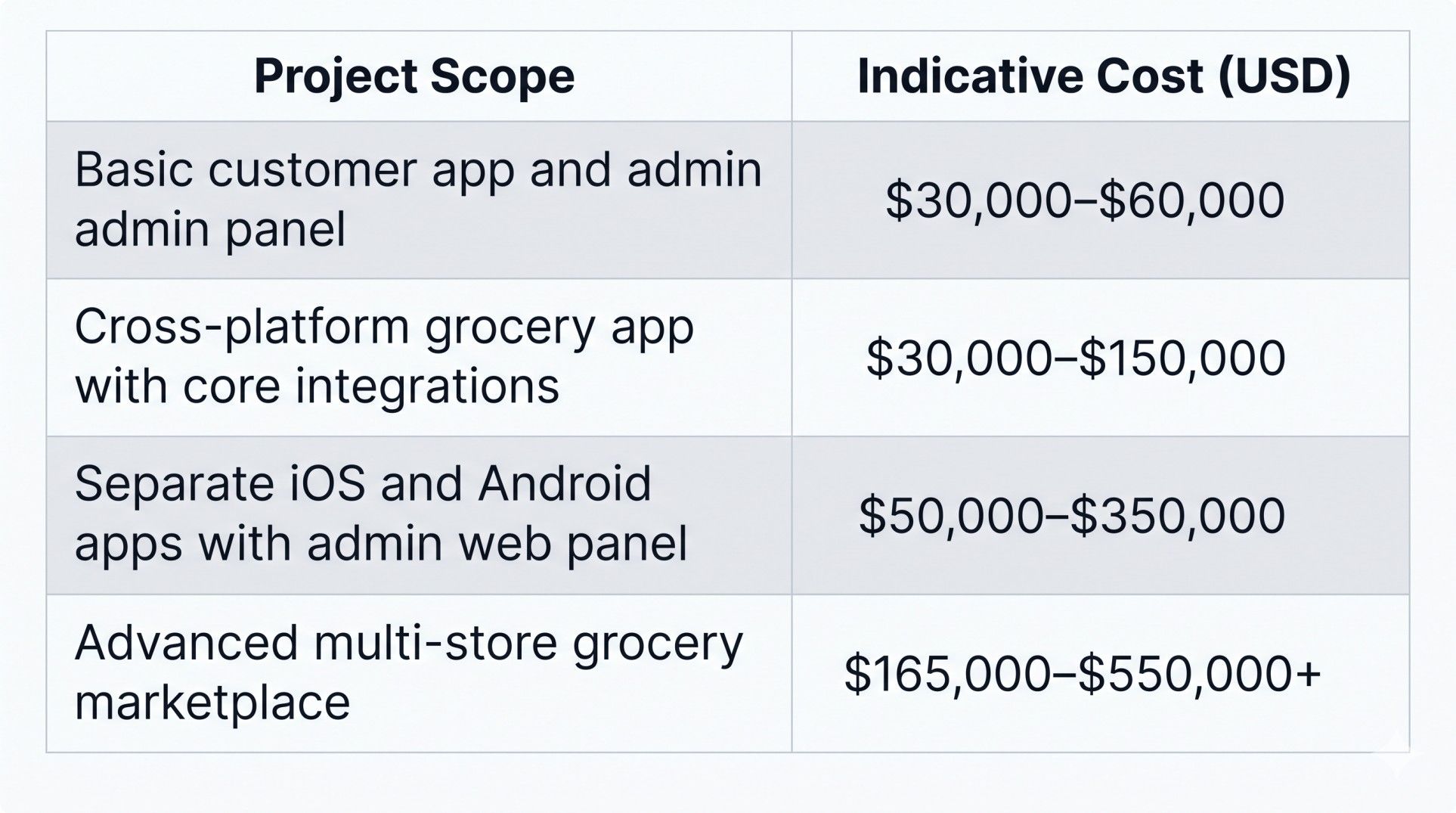
These ranges overlap because projects with the same label can have very different requirements. A basic customer app connected to a simple admin panel is substantially different from a marketplace with independent retailer accounts, shopper assignment, live delivery tracking, and inventory synchronization.
What affects the development budget?
- Number of applications: A customer app, vendor portal, shopper app, driver app, and admin panel each require development and testing. Some interfaces can be combined or introduced in later phases.
- Third-party integrations: Payments, maps, push notifications, analytics, POS systems, and inventory software can add implementation and ongoing subscription costs.
- Real-time functionality: Live location tracking, delivery estimates, instant stock updates, and order-status notifications require additional backend work and testing.
- Maintenance and infrastructure: Hosting, monitoring, security updates, bug fixes, and operating system compatibility need to be budgeted for after launch.
How can startups control the initial cost?
Start with a clearly defined MVP rather than building every feature found in Instacart. A practical first release may include registration, product search, a shopping cart, checkout, basic inventory management, order status, and an admin panel.Once the platform has real customers and order data, you can introduce additional stores, loyalty programs, advanced delivery routing, recommendations, and demand forecasting.
Request a feature-by-feature quotation and agree on acceptance criteria before development begins. This makes it easier to compare proposals and identify features that can safely wait until a later release.
FAQs
Q1. Is it worth building an Instacart-like grocery app in 2026?
It can be, particularly if the platform addresses a specific market need. Regional supermarkets, specialty food retailers, ethnic grocery stores, and subscription-based services can differentiate themselves through product selection, local knowledge, and reliable fulfillment rather than competing directly with national platforms on scale.Q2. What features are essential for a grocery delivery MVP?
Start with product catalogs, search, cart management, checkout, payment integration, order tracking, and basic administration. If multiple stores are involved, retailer management and store-level inventory also need to be addressed. Shopper and delivery workflows should be included when they are necessary for fulfilling orders.Q3. How long does grocery app development take?
A simple MVP may take around two to four months, depending on scope and team capacity. A mid-sized product may take four to eight months, while a complex multi-store ecosystem can require eight months or longer. These are planning estimates, and integrations or changing requirements can extend delivery.Q4. How do Instacart-like apps generate revenue?
Common models include delivery fees, service fees, retailer commissions, subscriptions, and sponsored product placements. The right combination depends on who fulfills orders, who pays for delivery, and whether retailers or brands are willing to pay for additional visibility.Q5. What should I ask before hiring a development company?
Ask for relevant project examples, an explanation of its inventory synchronization approach, details on substitutions and refunds, a clear project estimate, and confirmation of source-code ownership. Also establish how support, maintenance, and future feature development will work after launch.Final Thoughts
Choosing among grocery delivery mobile app development companies requires looking beyond the customer-facing design. Inventory accuracy, retailer coordination, order substitutions, and delivery management are what make a grocery platform practical to operate.For startups, the strongest approach is to define the business model first, build the essential workflows, and expand as customer demand becomes clearer. A development partner that understands these operational details can help turn an Instacart-style concept into a product that fits your market and budget.